Building Compassion Through Education: Our School Outreach Programs
Teaching the next generation about responsible pet ownership, animal emotions, and kindness to all living beings
At Sha Nini Foundation, we believe that creating a kinder community starts with education. Our school outreach programs are designed to instill values of compassion, empathy, and responsibility in children from an early age. Through interactive classroom visits, hands-on activities, and meaningful encounters with therapy animals, we're shaping a generation that understands the importance of treating all living beings with respect and care.
The Foundation of Our Educational Mission
Our educational outreach programs reach over 3,000 students annually across local elementary and middle schools. Each program is carefully crafted to be age-appropriate, engaging, and impactful. We don't just talk about animal welfare in abstract terms – we bring the lessons to life through real stories, interactive demonstrations, and the gentle presence of our certified therapy animals.
The curriculum we've developed covers essential topics including responsible pet ownership, understanding animal body language and emotions, the importance of spaying and neutering, wildlife conservation, and how to safely interact with animals. But beyond these practical lessons, we focus on something even more fundamental: teaching children that animals are sentient beings capable of feeling joy, fear, love, and pain – just like humans.
What makes our program unique is the integration of social-emotional learning with animal welfare education. We've found that when children learn to recognize and respond to the needs of animals, they simultaneously develop greater empathy for their peers and a stronger sense of social responsibility. The skills they learn in understanding animal behavior – patience, observation, gentle communication, and respect for boundaries – translate directly into improved interpersonal relationships.
Each classroom visit is led by our trained educators who work closely with teachers to align our content with existing curriculum standards. We incorporate science, language arts, and social studies elements into our presentations, making our programs valuable additions to the academic experience rather than simple diversions from regular coursework.
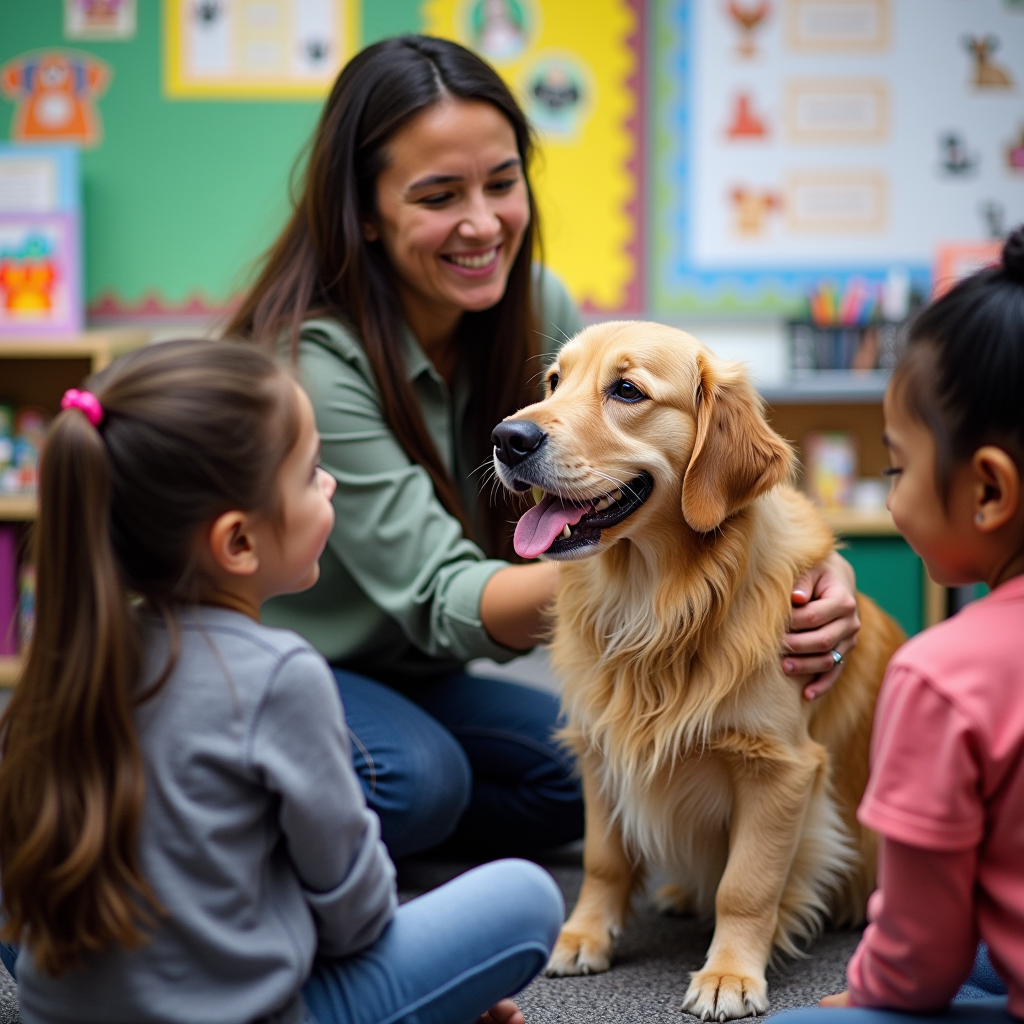
Students learning about animal emotions and safe interaction during a recent therapy animal visit
The Power of Therapy Animal Interactions
The highlight of every classroom visit is the time students spend with our certified therapy animals. These specially trained dogs, cats, and occasionally rabbits serve as living textbooks, demonstrating the concepts we teach in real-time. When children see a dog's tail wagging with genuine happiness or notice a cat's ears flatten when it feels uncomfortable, the lessons about animal emotions become immediately tangible and memorable.
Our therapy animals are carefully selected and trained not just for their calm temperaments, but for their ability to help children learn. During visits, students practice reading body language, asking permission before approaching, using gentle touches, and respecting an animal's space when it needs a break. These interactions are supervised by both our handlers and classroom teachers, ensuring safety while maximizing learning opportunities.
The impact of these encounters extends far beyond the immediate joy of petting a friendly dog. Research shows that interactions with therapy animals can reduce anxiety, improve focus, and increase engagement in learning. For many children, especially those who may not have pets at home or who have had negative experiences with animals, these positive interactions can be transformative. We've witnessed shy students blossom with confidence as they successfully connect with an animal, and we've seen children with behavioral challenges demonstrate remarkable patience and gentleness.
One of our most successful activities involves having students observe therapy animals in different situations and identify their emotional states. Is the dog happy, nervous, or tired? What clues tell us how the animal is feeling? This exercise in empathy and observation helps children develop critical thinking skills while learning to consider perspectives beyond their own – a fundamental component of emotional intelligence.
Voices from the Classroom: Teacher Testimonials
The transformation I've seen in my students since the Sha Nini Foundation's visit has been remarkable. We had one student who was particularly rough with classroom materials and struggled with impulse control. After learning about gentle touch and respecting animals' boundaries, I noticed him applying those same principles with his classmates. He's become one of our most considerate students. The program didn't just teach my kids about animals – it taught them about being better humans.
— Mrs. Jennifer Martinez, 3rd Grade Teacher, Riverside Elementary School
As a middle school science teacher, I was impressed by how well the Sha Nini Foundation's curriculum aligned with our standards on animal behavior and ecosystems. But what really stood out was the engagement level. Students who typically zone out during lectures were completely absorbed, asking thoughtful questions and making connections to their own experiences. Three weeks after the visit, students are still referencing what they learned. That kind of lasting impact is rare and valuable.
— Mr. David Chen, 7th Grade Science Teacher, Lincoln Middle School
The therapy animal visit was the highlight of our entire school year. I teach special education, and many of my students struggle with traditional learning methods. The hands-on, experiential approach of the Sha Nini Foundation program reached every single one of my students. I watched non-verbal students communicate their excitement through gestures and smiles. I saw students with anxiety relax and open up. The program created a safe, joyful learning environment where all my students could succeed.
— Ms. Sarah Thompson, Special Education Teacher, Oakwood Elementary School
These testimonials reflect a consistent pattern we've observed across all our school partnerships: the lessons learned through our program extend far beyond animal welfare. Teachers report improvements in classroom behavior, increased empathy among students, reduced bullying incidents, and enhanced social-emotional skills. The connection between learning to care for animals and learning to care for each other is powerful and undeniable.
Parent Perspectives: Changes at Home
The impact of our educational programs doesn't stop at the classroom door. Parents have shared numerous stories about how their children's participation in our outreach programs has influenced family dynamics and household decisions. Many families have reported that their children came home from our visits asking thoughtful questions about pet ownership, expressing interest in volunteering at animal shelters, or showing newfound gentleness with family pets.
"After the Sha Nini Foundation visited my daughter's classroom, she became passionate about animal welfare. She started a neighborhood pet-sitting service and donates half her earnings to the foundation. More importantly, she's become more responsible and compassionate in all areas of her life. The program sparked something special in her."
— Patricia Rodriguez, Parent
"We were considering getting a dog, but after my son's class participated in the responsible pet ownership program, we realized we weren't quite ready. Instead of being disappointed, my son understood and appreciated that we were making a responsible decision. He suggested we foster dogs until we're in a better position to adopt. His maturity and understanding impressed us deeply."
— Michael and Lisa Johnson, Parents
"My son has autism and has always struggled with understanding emotions – both his own and others'. After the therapy animal visit, something clicked. He started using the same techniques he learned for reading animal body language to better understand his classmates and family members. It's been a breakthrough for him socially."
— Karen Williams, Parent
These parent testimonials highlight an important aspect of our program's success: the lessons learned create ripple effects that extend into homes and communities. When children become advocates for animal welfare, they often inspire their entire families to make more compassionate choices. We've had families adopt pets from shelters after their children's participation in our program, households switch to cruelty-free products, and parents volunteer alongside their children at animal welfare events.
Measuring Impact: Behavioral Changes and Long-Term Effects
To ensure our programs are truly making a difference, we conduct pre- and post-program assessments in partnership with participating schools. The results have been consistently encouraging. Schools report an average 40% reduction in aggressive behavior incidents in the months following our visits. Teachers note improved conflict resolution skills, with students more likely to use calm communication and consider others' feelings before acting.
Academic performance also shows positive trends. Students who participate in our programs demonstrate increased engagement in science and social studies classes, particularly in units related to biology, ecology, and social responsibility. Reading comprehension scores improve when students are given texts about animals and animal welfare – topics they're now genuinely interested in and emotionally connected to.
Perhaps most significantly, we track long-term behavioral changes through follow-up surveys conducted six months and one year after program participation. The data shows that the majority of students retain the core lessons about empathy, responsibility, and kindness. Many continue to demonstrate the gentle, considerate behaviors they learned during our visits, applying them not just to animals but to all their interactions.
We've also documented an increase in youth volunteerism at local animal shelters and rescue organizations. Students who participate in our programs are three times more likely to volunteer with animal welfare organizations compared to their peers who haven't participated. This suggests that our programs are successfully inspiring the next generation of animal advocates and community volunteers.
Looking Forward: Expanding Our Reach
The success of our educational outreach programs has created demand that exceeds our current capacity. We have a waiting list of schools eager to participate, and we're working diligently to expand our team of educators and therapy animals to meet this need. Our goal for the coming year is to reach 5,000 students across 25 schools, nearly doubling our current impact.
We're also developing new program components to serve different age groups and learning environments. Our high school curriculum will focus on career opportunities in animal welfare, veterinary science, and conservation biology, helping students see how their passion for animals can translate into meaningful careers. For younger students, we're creating a picture book series that reinforces our core messages about kindness and responsibility in an age-appropriate, engaging format.
Additionally, we're piloting a teacher training program that will equip educators with the tools and resources to continue animal welfare education throughout the school year, not just during our visits. This train-the-trainer model will exponentially increase our reach and ensure that the lessons we teach become integrated into regular classroom instruction.
None of this expansion would be possible without the support of our community. Every donation to Sha Nini Foundation helps us reach more students, train more therapy animals, and develop more comprehensive educational materials. When you support our educational programs, you're not just helping animals – you're investing in the character development of children and the future of our community.
Get Involved
If you're a teacher or school administrator interested in bringing our educational outreach program to your school, we'd love to hear from you. Our programs are offered free of charge to all schools, made possible by the generous support of our donors and volunteers.
Parents and community members can support our educational mission by volunteering as classroom assistants, helping with therapy animal care and training, or making a financial contribution to help us expand our reach. Together, we can build a kinder, more compassionate community – one classroom at a time.
The Sha Nini Foundation's educational outreach programs represent our commitment to creating lasting change through education and empathy. By teaching children to recognize the emotions and needs of animals, we're helping them develop the emotional intelligence and compassion that will serve them throughout their lives. Every child who learns to treat animals with kindness becomes an advocate for a more humane world – and that's a future worth investing in.